
Principle: Hafiz Sherali – Architect
Born in 1964 in Karachi, Hafiz Sherali is a distinguished architect whose work spans private residences, corporate offices, civic institutions, and industrial projects. He completed his Bachelor of Architecture (B.Arch.) with a focus on Structural Mechanics in 1988 at the University of Notre Dame, USA, where he was recognized as a Notre Dame Scholar for academic excellence and awarded a merit-based scholarship. In 1991, he earned a Master of Science in Architecture Studies (S.M.Arch.S.) at the Massachusetts Institute of Technology, Cambridge, USA, under the Design for Islamic Societies program, a collaboration of the Aga Khan Programme for Islamic Architecture at Harvard and MIT.
After completing his studies, Hafiz began his professional career with Amirali Qamar Chartered Architects in Karachi in 1991. In 1998, he established Collaborative Design, a medium-sized architectural firm providing planning, architecture, and interior design services to corporate, residential, and industrial clients. Today, the firm comprises 40 professionals working on large-scale projects that span corporate headquarters, industrial facilities, institutional buildings, and residential developments. Hafiz has lectured at the Aga Khan Programme for Islamic Architecture at MIT, delivering lectures in the ‘Evening With’ series in 2011 and serving as a guest speaker for a course on Disaster-Resilient Design from 2012 to 2014.
In the early years of his career, Hafiz designed a series of striking private residences, known for their originality and attention to detail. Over time, his practice expanded to include larger-scale civic and commercial projects, including institutional, corporate, and industrial buildings. Despite this expansion, Hafiz has consistently maintained a design philosophy rooted in timelessness. For him, timeless architecture does not ignore the present; it transcends it, creating spaces that remain meaningful and relevant across generations.
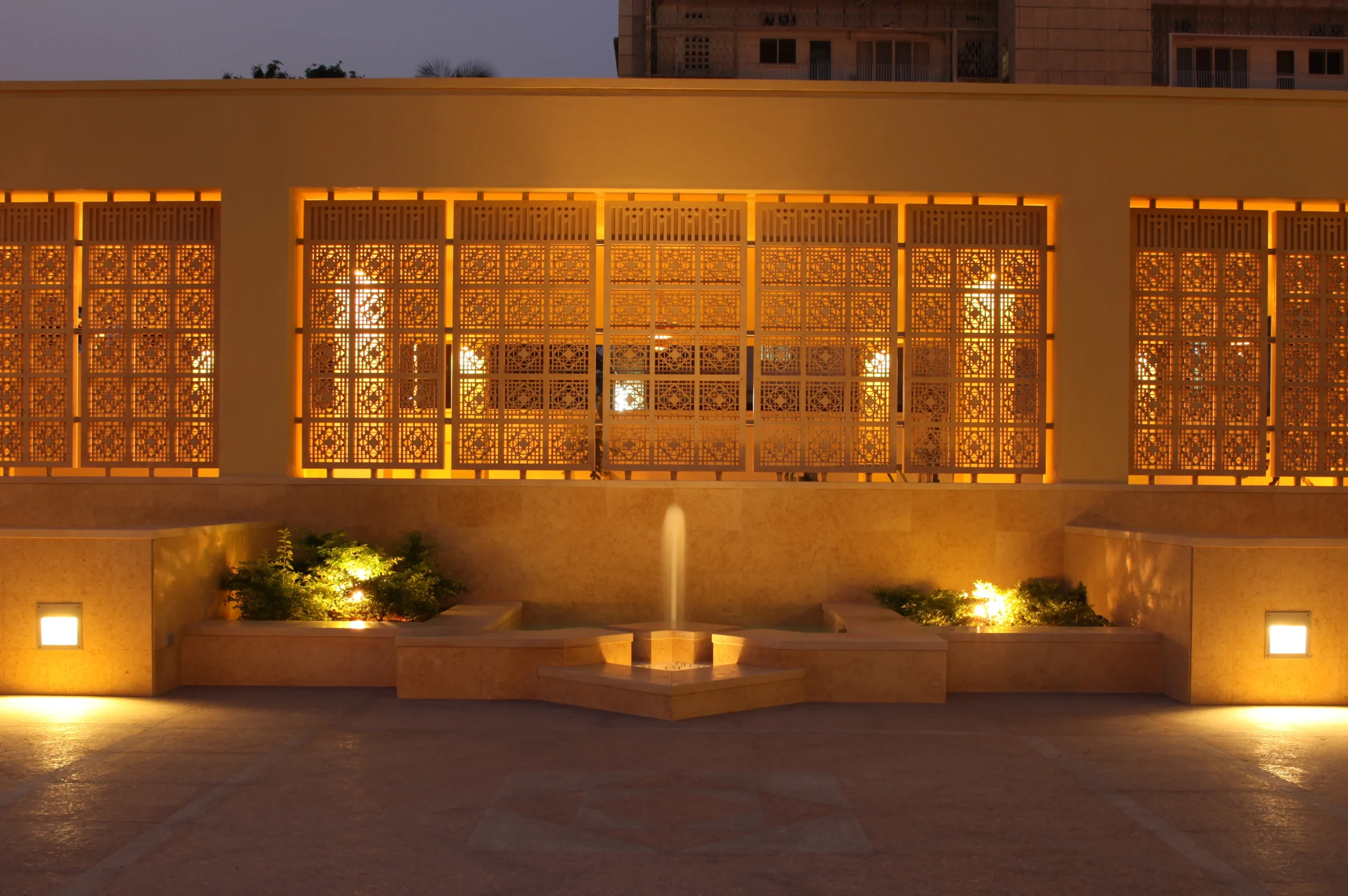
Hafiz has developed a distinctive architectural language that integrates modern design principles with a deep respect for tradition, materiality, and craft. He describes his approach as an “architecture of connection,” focusing on creating spaces that engage with their surroundings, harmonize with the environment, and foster human interaction. His buildings often bridge public and private spaces, invite social engagement, and serve as anchors within their communities. They are visually striking yet approachable, iconic yet functional, demonstrating a careful balance between aesthetic expression and contextual sensitivity.
His work is equally rich in experience and emotion as in form and composition. Hafiz believes that architecture has the power to inspire and uplift, and he seeks to achieve this through the poetic use of light, space, and proportion. His designs aim to create meaningful, memorable experiences for individuals and the collective, offering spaces that encourage reflection, connection, and community.
Over nearly three decades, Hafiz Sherali’s work has been distinguished by its elegance, sophistication, and profound attention to context. Each project reflects his commitment to quality, innovation, and human-centered design, whether it is a private residence, a corporate headquarters, or a civic institution. Through his practice, he has consistently sought to create architecture that transcends function, strengthens communities, and contributes to the cultural and environmental landscape of its surroundings.